
For clinics
Where the hidden workload accumulates
Important symptoms and questions arise between visits. Decisions are often made from fragmented recall. Follow-up becomes reactive. Patients seek guidance elsewhere when uncertainty arises, whether through portal messages, phone calls, or sometimes the emergency department.
Patient concern arises
A new symptom, a question about medication, or growing anxiety between scheduled appointments.
Current fragmented path
Portal messages, phone calls to the contact nurse, or in some cases an unnecessary visit to the emergency department.
Clinical consequence
Reactive follow-up, incomplete information at consultations, and avoidable workload for the care team.
What Oncoly enables
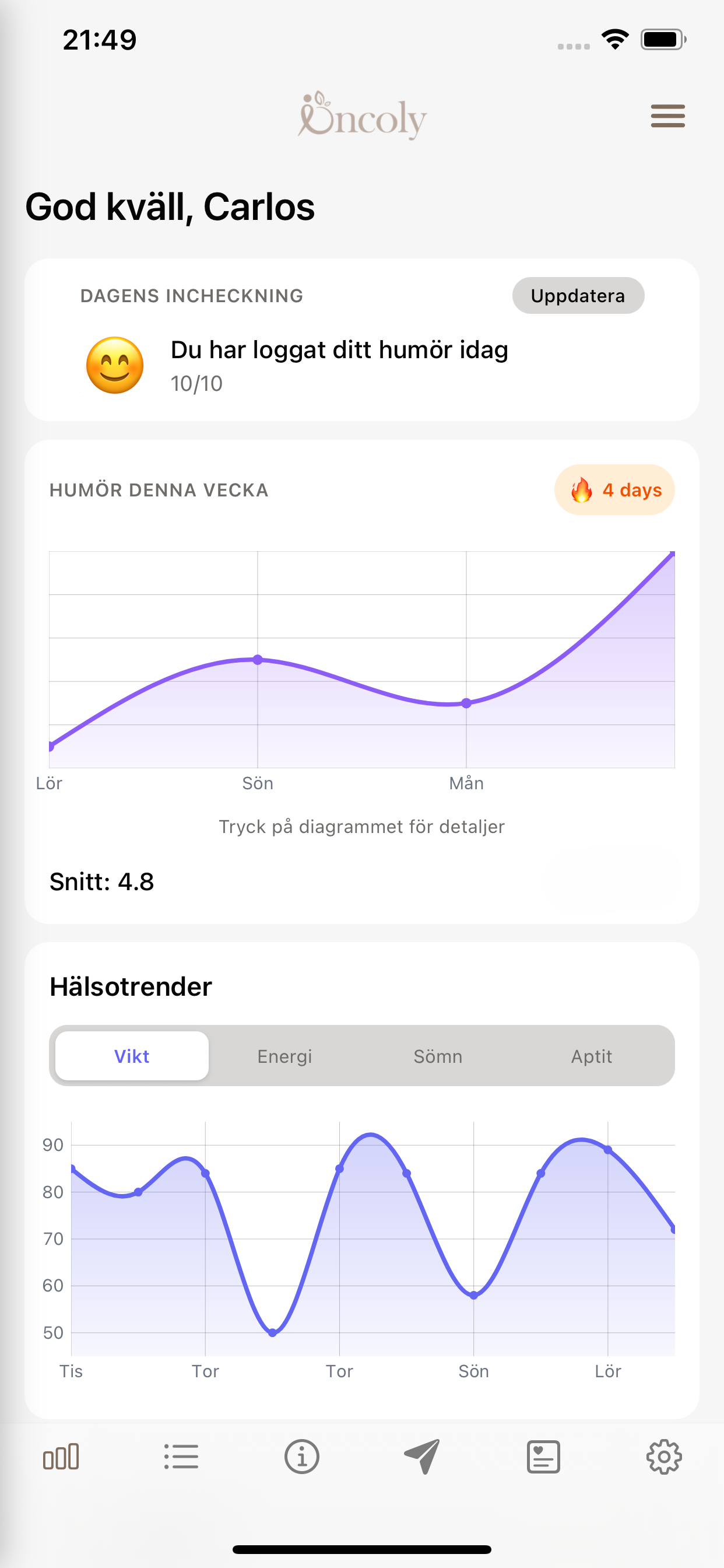
Structured patient-reported information between visits. Better consultation preparation. More individualized follow-up. Caregiver visibility with patient consent. Continuity without disrupting existing workflows.
For oncologists
Arrive at consultations with structured, patient-reported data that reduces reliance on fragmented recall.
For contact nurses
Fewer clarification calls. A clear timeline of what the patient has experienced since the last visit.
For caregivers
Consent-based visibility into the patient's reported wellbeing, without adding burden to the care team.
How it works

Patient controls who sees what
Illustrative operational impact for a medium-sized clinic, based on published evidence and Oncoly's applied analysis
24 min
Saved per oncologist visit
7.7 min
Saved per nurse contact
~13%
Reduction in unplanned clinical meetings per 100 visits
For a clinic managing ~50 oncology patients over a 15-month treatment pathway, Oncoly's structured coordination support is estimated to free over 40 hours of oncologist consultation time and nearly 13 hours of contact nurse effort, based on peer-reviewed evidence from McMullen et al. (2014) and Braut et al. (2025).
References available on request
A low-risk pilot to explore measurable operational value
We designed Oncoly to slot alongside existing workflows without requiring EHR integration. A pilot can start with a small patient cohort, typically up to 50 patients, 2 oncologists, and 5 contact nurses, with a defined evaluation period and continuation decision based on agreed metrics.